
Story Canvas
Project Title
Story Canvas — end-to-end redesign of a partner-facing platform for building, managing, and reusing customer engagement scenarios.
Platform used by solution partners of a major enterprise software vendor to build reusable "scenarios" (structured customer narratives) that get turned into presales and delivery outputs such as Discovery Flows, Value Journeys, and Interactive Guides.
Objective
Reimagine the tool from the ground up: turn a hard-to-read, disconnected legacy system into a clear, guided, AI-supported platform where partners can build once and reuse everywhere — and, for the first time, create Discovery Flows themselves instead of depending on the vendor's internal team.
Context
The building-block model — Demo Steps, Hero Steps, Bricks, Segments — already existed under the hood, but nothing in the tool explained it. Partners saw flat tables of modules with no visible relationship between them, no sense of what a given module would eventually become, and no guidance on which output format actually fit their situation. Forms were long and ungrouped. There was no home base — no overview of what you'd built, what was popular, or what to do next. The result: partners under-used the tool, recreated similar content deal after deal, and — critically — could not produce Discovery Flows at all. Discovery Flows had always been hand-built by an internal vendor team and handed to partners, which made them a bottleneck rather than something partners could reach for on their own.
My role
Sole Lead UX Designer, owning the project end to end — research, IA, interaction design, UI, and usability testing — from initial assessment through hi-fi design, working directly with a PM and development squads to bring it to implementation.
Assessment of current solution & partner interviews
↓
AI-assisted synthesis of interview & workshop data into themes and journey pain points
↓
Mapping the full scenario→output journey & information architecture
↓
Clarifying the building-block model and introducing a new block
↓
Concept exploration incl. AI-assisted content and prototyping flows
↓
Low-fi wireframes & rapid AI-generated prototype variants for early flow validation with stakeholders
↓
Hi-Fi UI
↓
Usability testing & iteration
↓
Shipping to dev + implementation oversight
↓
Analytics instrumentation, post-launch research & continuous iteration
My process
PROJECT OVERVIEW
Problem statement
Give solution partners a single, clearly explained way to build a customer scenario once, understand what it produces, and confidently reuse it across many deals and formats — including formats they previously couldn't create themselves.


The model where Scenario consisted of building blocks (Demo steps - Bricks - Segments etc.) already existed, but was never explained or properly visualized — partners couldn't tell how those blocks are connected and how their work relates to each of them
No visual connection shown between a scenario and the output formats it could generate
No block existed to support partner-built Discovery Flows — these were built exclusively by an internal vendor team on request
Forms for creating content were long, offered no guidance on how to fill them in and what would be a good presentation
No overview experience — partners had to already know exactly what they were looking for
Possibility to only re-use what already existed or create something from 0 with no guidance
No ability to share your blocks with others
Visual inconsistency, unattractive UI

CURRENT STATE

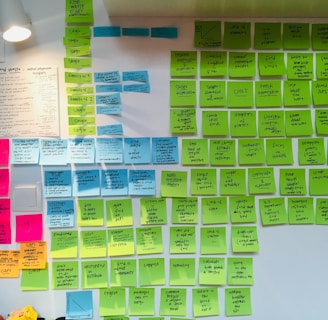
Through partner interviews and journey mapping — synthesized with AI-assisted thematic analysis to work through a large volume of interview and workshop notes quickly — three needs kept surfacing:
"Let me see the whole picture" — partners needed to understand how a scenario was assembled and what it would become, before committing time to building it
"Let me build the things I currently have to wait for" — Discovery Flows in particular were a recurring frustration: partners wanted to shape their own customer narrative rather than submit a request and wait on the internal team
"Tell me what's good, not just what's possible" — partners weren't format experts; they needed guidance on which output actually fit their situation, and what each one even was
Problems this created for the business:
Discovery Flow requests created a dependency bottleneck on a small internal team
Duplicated effort across partner teams building near-identical content
Inconsistent customer narratives across regions and deals
Low adoption of newer output formats simply because partners didn't understand what distinguished them
No visibility for the vendor into what partners were actually creating or reusing
USER NEEDS (JBTD) & PROBLEMS





A new Dashboard became the home base: recent modules, recently viewed scenarios, key stats (created modules, repository size, total views), and a direct path back into unfinished work — replacing a cold table view with a place that orients partners the moment they log in.
Each output format is now presented in plain language, with a live preview and "Best used for" guidance, so choosing a format is a confident decision rather than a guess:
Discovery Flow — an elaborate, landing-page-like experience built from Hot Topics, designed to be presented on large touchscreens or shared on a computer to open a customer conversation around industry trends and value drivers, before the solution is introduced
Value Journey — a structured, step-by-step script guiding the partner through exactly how to present a demo and what to say at each stage, connecting product capabilities to the customer's desired outcomes
Interactive Guide — closer to an interactive book, walking through the solution narrative in a way that keeps the emphasis on how the solution solves the customer's specific challenges
AI was woven into the platform at the point of need — drafting scenarios from uploaded notes, suggesting content for modules — always leaving the partner in control to edit and approve.
CONCLUSIONS

Based on research, the platform was restructured around a clear building-block hierarchy that mirrors how partners actually think about a customer story (starting from big picture, through strategic parts into small details like individual demo step), with each level explicitly visualized and linked so a partner can zoom out to see the whole scenario or zoom into a single module and always see what it feeds into.
A canvas page was created where user could see the whole scenario path, move/ remove the blocks, quickly edit or add blocks.
Hot Topics were introduced as a new block specifically so partners could assemble their own Discovery Flows — deep-dive discovery content exploring industry trends, challenges, and value drivers — without depending on the internal vendor team. This was one of the most requested changes surfaced in research, and structurally the biggest addition to the platform.
Three ways to start were introduced instead of one blank form:
Start from a vendor-provided template — official, structured, ready to adapt
Start from your own storyline — AI drafts a first version of a scenario from a partner's existing notes or documents
Reuse & adapt for a customer — clone and localize an existing scenario instead of rebuilding
Removed the Discovery Flow dependency bottleneck entirely — partners could self-serve a format that previously required going through an internal vendor team
No usage analytics existed prior to this redesign — introducing a strategy for following analytical data, giving the business its first real visibility into how partners actually used the platform
Feedback gathered from partners and enablement leads during post-launch usability sessions consistently cited the redesigned tool as clearer, faster to work in, and easier to trust than the previous version
Partners reported more confidence choosing the right output format, directly attributed in feedback to the plain-language guidance and previews introduced during the redesign
Post-launch analytics and continued usability testing fed an ongoing roadmap of refinements, rather than the one-off delivery the legacy tool had received
FINAL DESIGN

Clear visual hierarchy connecting every building block to the whole Scenario and to the outputs it produces
A new Hot Topics block enabling partners to self-serve Discovery Flows for the first time
Guided, templated creation flows instead of blank forms
A Dashboard giving partners orientation, recent activity, and platform-wide visibility from the first click
AI-assisted scenario and content creation, reducing the effort of getting to a first draft
A "Generate Formats" step that explains and previews the right output for the situation, rather than a list to pick from blind
Consistent, reusable components pulled into the shared Design System, so new modules and future output types could be added without re-inventing UI patterns
IMPACT


AI showed up in two distinct ways on this project, which is worth calling out on its own:
As a design tool, in how I worked — I used AI to synthesize a large volume of partner interview transcripts and workshop notes into themes and pain points during discovery, which meant more time could go into interpreting and validating findings with the team rather than manually coding every transcript. I also used AI to generate fast, disposable prototype variants during concept exploration, letting us put more directions in front of partners early instead of hand-building each option.
As a product capability, for the end user — AI features were designed directly into the partner-facing product: drafting a first version of a scenario from a partner's own notes or documents, and suggesting content for individual modules — always as an editable starting point, never a replacement for the partner's judgment.